Will My GLP-1 Hurt My Eyes? A Drug-by-Drug Look at the Actual Research
Last week the FDA added an eye warning to every GLP-1 on the market. Since then I’ve seen everything from “nothing to worry about” to “these drugs make you go blind.” Neither one is true, and neither one helps you decide anything.
So I did what I used to do as an engineer when two people were yelling different answers at me: I went and got the data. This post is long because the question deserves it. It covers each drug separately — semaglutide, tirzepatide, the older ones, the new Foundayo pill, and retatrutide — plus who’s actually at risk and how this stacks up against other things that threaten your eyes.
Quick disclaimer, the honest kind: I’m not a doctor. I’m a guy on Zepbound who reads studies (here’s my last GLP-1 research roundup). Use this to have a better conversation with your doctor, not to replace one.
First, how rare is NAION?
The main concern is NAION, a “stroke of the eye” where blood flow to the optic nerve drops and you lose vision in one eye, suddenly and usually for good. In adults over 50, it hits roughly 2.3 to 10.2 people per 100,000 per year. That’s somewhere between about 1 in 10,000 and 1 in 43,000 people in a given year.
It’s more common in people with diabetes. In the FDA’s own real-world data on diabetics, the rate ran about 26 to 32 cases per 100,000 per year no matter which diabetes drug they took. Keep that in mind. The disease itself carries a lot of the risk.
Relative risk vs. real risk (this is the whole ballgame)
Most headlines report relative risk: “doubles your risk!” Double a very small number and you still have a small number.
A 2026 analysis in Diabetes Care pooled the research and found GLP-1 users had about 1.7 times the odds of NAION. Sounds bad. But the actual risk in GLP-1 users was 0.09%, and the extra risk worked out to about 1 additional case for every 2,700 people treated. The same analysis found no increase in eye problems overall.
The FDA’s trial review found the same small picture: 6.4 cases per 100,000 per year on GLP-1s versus 3.8 on placebo or other drugs — about 2.6 extra cases per 100,000 people per year.
Drug by drug
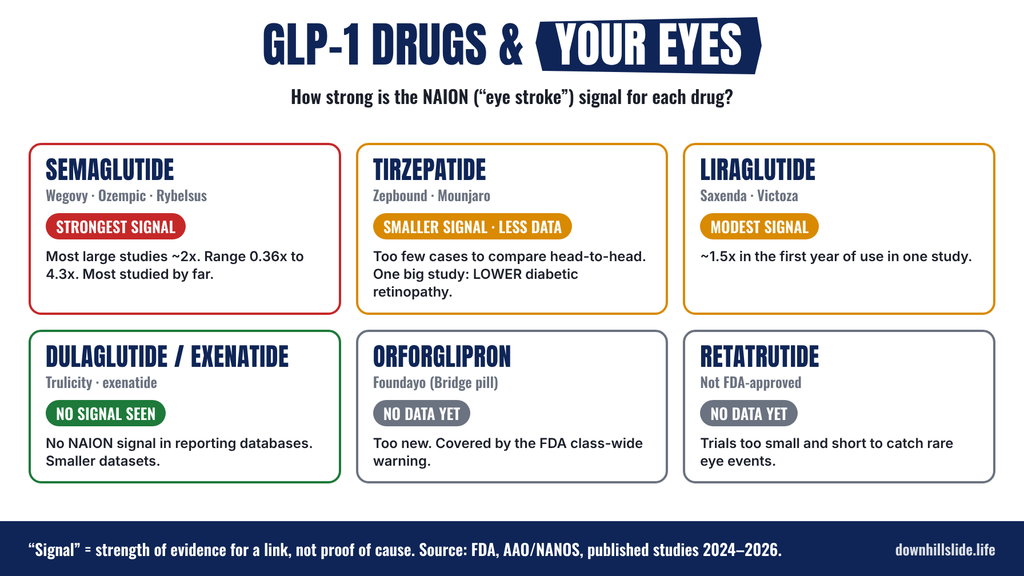
Semaglutide (Wegovy, Ozempic, Rybelsus) — the strongest signal, and the most studied
Almost all the alarming headlines trace back to semaglutide, partly because it’s been around longest and the most people take it.
| Study | Who | Result |
| Hathaway, JAMA Ophthalmology, 2024 (the one that started it) | One referral eye center; type 2 diabetes and obesity patients | 4.3x risk in diabetics; 7.6x in overweight/obese. Small numbers: 20 cases vs. 3 in the obesity group. |
| Danish registry, 2024 | 424,152 people with type 2 diabetes | About 2.2x risk |
| Scandinavian registries, 2025 | Denmark and Norway | About 2.8x risk vs. SGLT-2 pills |
| U.S. Veterans Affairs, JAMA Ophthalmology, Feb 2026 | 102,361 veterans with diabetes | 2.3x risk. Actual rates: 0.29% vs. 0.13% over about two years |
| Military Health System, 2025 | 1.2 million patients | Diabetics on semaglutide had lower odds (0.36x); no link in overweight/obese patients |
Notice the pattern. The biggest numbers come from the smallest, most specialized study. Most large studies of diabetics land around 2x. One huge military study found no increase at all.
The number that matters most for most Bridge members: in the Scandinavian data, people on semaglutide without diabetes had 8 NAION cases among 156,937 users — about 5 cases per 100,000 per year. That’s inside the normal background range for people over 50. Europe’s regulator, looking at semaglutide overall, estimated NAION affects up to 1 in 10,000 users.
Tirzepatide (Zepbound, Mounjaro) — less data, smaller signal so far
This is the one I take, so I looked hard. The short version: there’s much less research, and what exists looks better than semaglutide’s — but “less data” isn’t the same as “safe.”
- A large 2025 study in JAMA Network Open lumped semaglutide and tirzepatide together and found 0.04% vs. 0.02% NAION over two years (about 1.8x). When the researchers compared the two drugs directly (3,806 patients each), there were 2 NAION cases on semaglutide and 1 on tirzepatide. That’s far too few to call a winner.
- A study presented at the 2025 American Academy of Ophthalmology meeting found no significant link between tirzepatide and NAION, or between tirzepatide and diabetic retinopathy.
- In worldwide side-effect reporting databases, tirzepatide’s NAION signal is a small fraction of semaglutide’s. Those databases show reporting patterns, not risk, but the gap is consistent.
- Eye doctors’ official position: the evidence on tirzepatide is too thin to say, so don’t assume the concern is limited to semaglutide.
- One genuinely good finding: a Weill Cornell study of about 174,000 diabetic patients found tirzepatide users were less likely to develop diabetic retinopathy (0.49% vs. 1.2% for mild cases) than similar patients using lifestyle changes alone.
Liraglutide (Saxenda, Victoza) — the older daily shot
One study tied first-year liraglutide use to about 1.5x NAION risk. Its signal in side-effect reporting databases is real but much smaller than semaglutide’s.
Dulaglutide (Trulicity) and exenatide
No NAION signal in the worldwide reporting databases, and one large study found no association for dulaglutide. These drugs have smaller datasets, so absence of evidence isn’t proof. But they’ve never been the drugs behind the headlines.
Orforglipron (Foundayo) — the new Bridge pill
Foundayo is covered by the FDA’s class-wide warning. I couldn’t find any published study looking specifically at Foundayo and NAION. It’s simply too new. Its label tells type 2 diabetics to report any vision changes. Unknown is not the same as dangerous, but it’s unknown.
Retatrutide — the “triple agonist” everyone’s waiting for
Retatrutide isn’t FDA-approved yet, so it’s not on the market or in the Bridge. Nothing eye-related has stood out in the trial results released so far. But those trials weren’t built to catch something as rare as NAION, and rare problems usually show up only after a drug is in millions of people. Its stand-out side effect so far is skin tingling and sensitivity, not eyes.
The other eye issues people ask about
- Diabetic retinopathy: In semaglutide’s big heart trial, diabetics had more retinopathy complications. That’s concentrated in people who already had retinopathy, had high blood sugar, and saw it drop fast. Bigger reviews since then are reassuring, and one 2026 analysis found GLP-1 users were less likely to progress to the severe form. Zepbound’s and Mounjaro’s labels tell patients with a history of retinopathy to be monitored.
- Wet macular degeneration: An Ontario study of diabetics aged 66 and up found 0.2% vs. 0.1% over about three years — double the risk, but still small. Nearly all were on semaglutide, and an outside expert noted the study didn’t account for body weight.
- Dry macular degeneration: A Cleveland Clinic study found five years on a GLP-1 was linked to a 63% lower risk than metformin.
- The second eye: After NAION in one eye, about 15% of people get it in the other eye within five years. A study presented at the 2026 eye doctors’ meeting found that, among people who lost both eyes, GLP-1 users were more likely to lose the second one within six months (57% vs. 41%). That study can’t prove the drug caused it, and the GLP-1 users had worse blood sugar.
How does this compare to other risks?
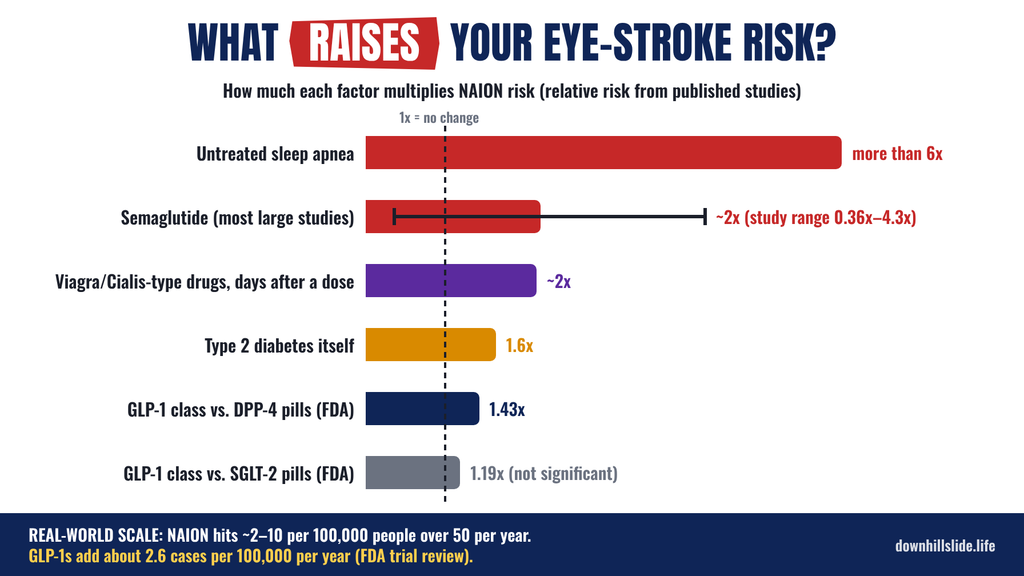
| Risk factor or drug | How much it raises NAION risk |
| Untreated obstructive sleep apnea | More than 6x |
| Semaglutide, most large studies | About 2x (range: 0.36x to 4.3x) |
| Viagra/Cialis-type drugs, in the days right after a dose | About 2x |
| Type 2 diabetes itself | About 1.6x |
| GLP-1 class vs. DPP-4 diabetes pills (FDA data) | 1.43x |
| GLP-1 class vs. SGLT-2 diabetes pills (FDA data) | 1.19x (not statistically significant) |
For contrast, here’s a drug people take for years with a well-known eye risk: hydroxychloroquine (Plaquenil), used for lupus and arthritis. About 7.5% of long-term users show retinal damage on careful testing — which is why they get regular eye screening. That’s a different eye problem, but it shows the scale. GLP-1 NAION risk is measured in cases per 100,000. Plaquenil’s is measured in percentages.
Other common medicines with eye side effects
GLP-1s aren’t the first everyday medicines with eye warnings, and they won’t be the last. Here are some drugs plenty of people our age already take, for perspective:
- Steroids (prednisone pills, steroid eye drops, inhalers, nasal sprays, creams): can cause cataracts (a type at the back of the lens) and steroid-induced glaucoma from raised eye pressure. About 4–6% of people are “high responders” whose eye pressure jumps sharply, and the risk rises with dose and how long you use them.
- Amiodarone (Pacerone, Cordarone; a heart-rhythm drug): leaves harmless deposits on the cornea in 70–100% of long-term users. More rarely, it injures the optic nerve in a way that looks a lot like NAION, in 0.36% to 2% of users.
- Hydroxychloroquine (Plaquenil; for lupus and arthritis): retinal damage shows up in about 7.5% of long-term users on careful testing.
- Viagra/Cialis-type drugs: about 2x the NAION risk in the days right after a dose.
- Tamsulosin (Flomax; for an enlarged prostate): causes “floppy iris” during cataract surgery. It doesn’t harm your eyes day to day, but your cataract surgeon needs to know you take it.
A few things stand out:
- Steroids are the sneaky one. It’s not just pills. Eye drops, inhalers, nasal sprays and even skin creams can raise eye pressure in people who are sensitive to them, and glaucoma has no symptoms until vision is already lost. If you use a steroid regularly, make sure your eye doctor knows and checks your eye pressure.
- Amiodarone’s optic nerve risk is far bigger than the GLP-1 risk. It affects somewhere between 1 in 280 and 1 in 50 users, compared with a few extra cases per 100,000 people per year on GLP-1s. Unlike NAION, it tends to come on slowly and can affect both eyes. Amiodarone is still prescribed every day because for many heart patients, the benefit outweighs the risk. That’s the same trade-off we make with GLP-1s.
- Tamsulosin is a “tell your surgeon” drug, not a danger drug. The FDA added a label warning in 2005. Eye surgeons say you don’t need to stop it, but if you’re having cataract surgery, tell them you take it (or ever took it) so they can adjust their technique.
The takeaway: almost every drug with real benefits has some eye risk attached. The goal isn’t to avoid all of them. It’s to know which ones you take, tell your eye doctor, and keep up with your exams.
So who is actually at risk?
Eye specialists point to these:
- Type 2 diabetes, especially with high or rapidly falling blood sugar
- Sleep apnea, especially untreated — the single biggest risk factor on the list
- Blood pressure that drops too low overnight (sometimes from taking BP meds at bedtime)
- A small, “crowded” optic nerve — something an eye exam can see
- Prior NAION in one eye
- Age over 50, and vascular disease in general
What does this mean for the average Bridge member?
The Bridge program excludes people with type 2 diabetes and moderate-to-severe sleep apnea, so Bridge members skip the two biggest risk factors by design. Most of the scariest studies were done in diabetics. The best non-diabetic number I found (about 5 cases per 100,000 per year on semaglutide) sits inside the normal background rate for people our age. That’s my reading of the evidence, not a study of Bridge members specifically.
If you’re a typical Bridge member, the realistic risk is a few cases per 100,000 people per year. That’s real enough to know the warning signs, and nowhere near enough to give up a drug that’s helping your heart and your weight.
What I’d do (and what I’m doing)
- Learn the warning sign: sudden vision loss in one eye, often on waking. Get seen the same day.
- Don’t stop your GLP-1 on your own. The eye doctors’ societies specifically warn against that.
- If you snore or wake up exhausted, get a sleep study. Untreated sleep apnea is a bigger eye risk than the drug.
- If you take blood pressure meds at night and get lightheaded, ask your doctor about timing.
- Keep your regular eye exams, especially if you have any diabetic eye history.
- If you’ve had NAION in one eye, talk it through with your doctor and an eye specialist before starting a GLP-1.
The full rundown on the Bridge drugs, how to qualify, and what to watch for is in my book, The Medicare GLP-1 Bridge Guide — link below. And if you’ve had a vision change on one of these drugs, I’d like to hear about it in the comments.
Sources
- U.S. FDA, Drug Safety Communication on GLP-1 RAs and NAION, Nov. 9, 2026 (via Endocrinology Advisor, PharmExec and Neo Science Hub coverage).
- Diabetes Care, “Association Between GLP-1 Receptor Agonists and Ischemic Optic Neuropathy: A Meta-analysis,” Jan. 2026.
- Diabetes Care, “GLP-1 RAs and Risk of Optic Nerve or Vision-Threatening Events: A Meta-analysis of RCTs,” Jan. 2026.
- NANOS / American Academy of Ophthalmology consensus statement on GLP-1 RAs and NAION, May 2026; AAO news release, Sept. 22, 2026.
- Hathaway et al., JAMA Ophthalmology, July 2024 (via AAO consensus statement and summaries).
- Heberer et al. (VA), JAMA Ophthalmology, Feb. 2026 (via Ophthalmology Times and Physician’s Weekly).
- Lieberman et al., Military Health System study, Military Medicine, 2025 (via Healio, Apr. 2026).
- Wang et al., “Semaglutide or Tirzepatide and Optic Nerve and Visual Pathway Disorders in Type 2 Diabetes,” JAMA Network Open, Aug. 2025.
- Li, Peng & Lei, “Divergent ocular safety profiles of GLP-1 receptor agonists,” Frontiers in Medicine, Sept. 2026 (per-drug study and reporting-database summary, including Simonsen 2025 Scandinavian data).
- Retinal Physician, “GLP-1 drugs show mixed effects on eye health” (AAO 2025 meeting studies).
- Weill Cornell Medicine, tirzepatide and diabetic retinopathy study, Ophthalmology, 2026.
- Shor et al., “GLP-1 RAs and risk of neovascular AMD,” JAMA Ophthalmology, 2025 (via The Pharmaceutical Journal).
- AAO 2026 meeting, second-eye NAION study (via Newswise and Eyewire).
- Campbell et al., PDE5 inhibitor case-crossover study (ClinicalTrials.gov NCT00759174).
- Meta-analyses on sleep apnea and NAION and on diabetes and NAION (Chen et al., PLoS One, 2013).
- Melles & Marmor, hydroxychloroquine retinopathy, JAMA Ophthalmology, 2014.
- Retatrutide eye-safety summary, Doctronic, 2026; Lilly TRIUMPH trial releases.
- Meng et al., “Amiodarone-related keratopathy and optic neuropathy: case report and literature review,” Frontiers in Medicine, April 2025; EyeWiki (AAO), “Amiodarone Associated Optic Neuropathy.”
- StatPearls (NCBI Bookshelf), “Steroid-Induced Glaucoma”; Moran CORE (University of Utah), “Ocular Adverse Effects of Systemic Medications: Steroids.”
- ASCRS/AAO Educational Update Statement on intraoperative floppy iris syndrome (IFIS) and alpha-1 blockers.