Let’s talk numbers, because “free money” and “your tax dollars” language gets thrown around a lot with this program and almost nobody explains what it actually means.
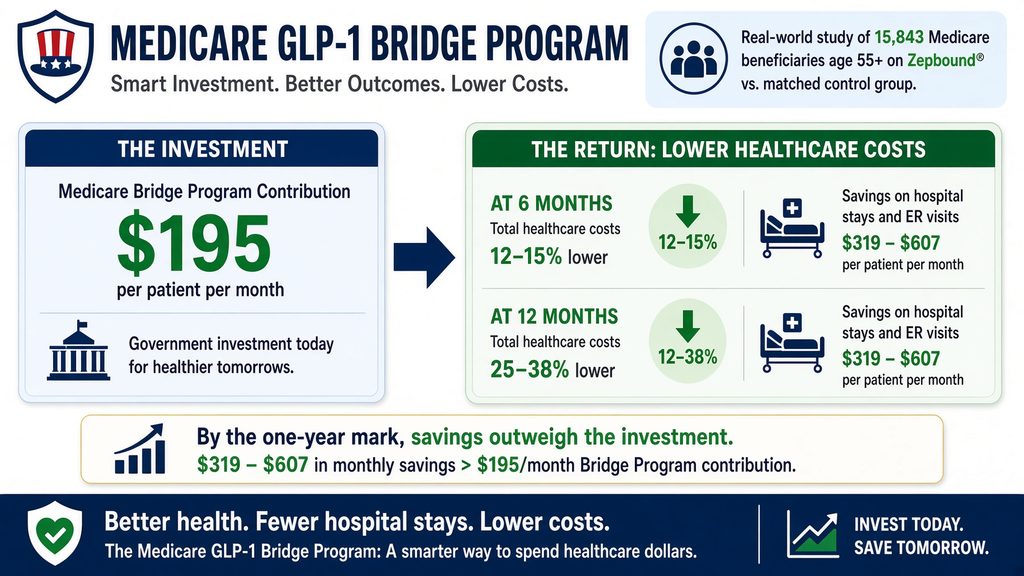
The Medicare GLP-1 Bridge negotiated Zepbound and Wegovy down to $245 a month. You pay $50. Medicare — meaning taxpayers — covers the other $195. Multiply that by millions of people and you start to see why budget people are losing sleep.
Total Medicare Part D spending on GLP-1 drugs hit $27.5 billion in 2024. That’s a fivefold jump since 2019. And that’s before the Bridge program existed. The Congressional Budget Office ran the numbers on what it would cost Medicare to cover anti-obesity drugs more broadly and landed on roughly $35 billion in federal spending between 2026 and 2034. Their near-term math is blunter: about $5,600 per user in 2026, against maybe $50 per user in offsetting savings elsewhere in the system. By the government’s own accounting, this doesn’t pay for itself fast.
Here’s the pushback, and it’s a good one: a real-world study of 15,843 Medicare beneficiaries 55 and older on Zepbound (matched against a control group of people with the same profile who weren’t on it) found their total healthcare costs were 12–15% lower at six months and 25–38% lower at twelve months — somewhere between $319 and $607 per patient per month in savings on hospital stays and ER visits. By the one-year mark, those savings were bigger than the $195/month the government is kicking in.
Worth knowing: that study was funded by Eli Lilly, the company that makes Zepbound, and it didn’t include the cost of the drug itself in the “savings” math — just other healthcare spending. That doesn’t make the numbers fake, but it does mean you should read “savings” as “savings on everything except the drug,” and wait for independent replication before treating it as settled.
So which is it — a $35 billion budget problem or a program that pays for itself in a year? Probably both, depending on which year and which patient you’re looking at. Short-term, it’s expensive. Long-term, for the right patients, it may genuinely offset itself. That’s not a dodge — that’s just what the data says right now, from two very different sources with two very different incentives.
None of this touches the actual hassle of getting the paperwork through — Humana administers the Bridge program, and providers at a recent New York policy roundtable said prior authorization alone can eat up 10 days of billing-code back-and-forth before a patient ever gets their first pen. That friction is its own hidden cost, just not one that shows up in a CBO spreadsheet.
Here is my personal timeline showing, from a patient level, the back-and-forth. This also impacts the Primary Care Physician. Every Medicare patient must submit to the Bridge program through their PCP listed on their plan.
July 2: PCP first appointment
July 2: Call from Walgreens saying it needed preauthorization from PCP and UNC
July 9: Call from PCP telling me UHC requires a second appointment
July 14: Second appointment with PCP to review and submit more paperwork
July 14: Call from Walgreens telling me the Zepbound was ordered at $500+/ pen (Cash w/o the Bridge Program since prior authorization was not complete)
July 16: Call from Walgreens saying they needed another preauthorization from PCP/UHC
July 17: Call from PCP saying they were sending more info to UHC
July 21: Call from Walgreens saying they did not have the KwikPen in stock and ordered it. Confirmed it was the $50 cost of the Medicare GLP-1 Bridge program.
July 23: Call from Walgreens: KwikPen was in, and the cost was $50
July 24: Picked up the Zepbound KwikPen from Walgreens
If you want the real play-by-play on getting through that paperwork instead of losing 10 days to it, that’s a whole chapter in The Medicare GLP-1 Bridge Guide. Link’s below.
Sources
- AJMC, “As GLP-1 Costs Climb, Medicare Part D Plans Face a Reckoning,” Aug. 26, 2026.
- Congressional Budget Office, Publication 60816 (fiscal impact of Medicare anti-obesity drug coverage).
- BioSpace / Eli Lilly and Company, real-world Zepbound cost study press release, Aug. 26, 2026.
- AJMC / RealClearHealth, coverage of New York obesity-care policy roundtable, Aug. 26, 2026.