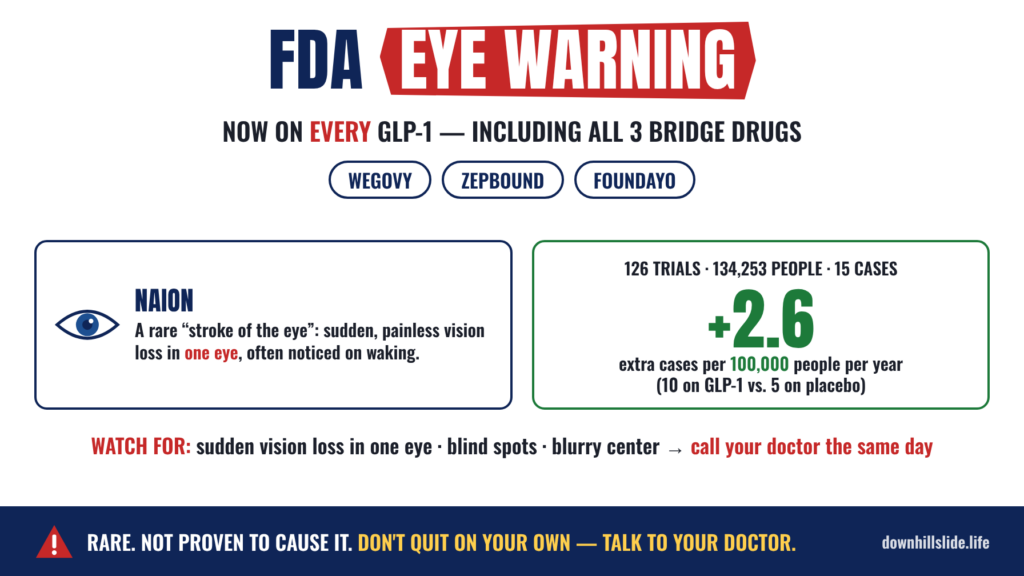
On Monday, November 9, the FDA told every company that makes a GLP-1 drug to add a new warning to the label. Not just Ozempic. Every one of them. That includes all three Bridge drugs — Wegovy, Zepbound, and Foundayo — plus Ozempic, Mounjaro, Rybelsus, Trulicity, Saxenda, Victoza and the rest of the family.
The warning is about a rare eye condition called NAION, and the headlines this week went straight for the throat: “sudden blindness,” “eye stroke,” “permanent vision loss.” If you’re on one of these drugs (I’m on Zepbound through the Bridge myself), that’s a lousy way to start your morning coffee.
So let’s do what most of the headlines didn’t. Let’s look at the actual numbers.
What NAION is
NAION stands for non-arteritic anterior ischemic optic neuropathy, which is why everybody just says NAION. Blood flow to the front of the optic nerve drops, and you lose vision in one eye — suddenly, without pain, and often you notice it when you wake up. Doctors call it a “stroke of the eye.” There’s no proven treatment, and the damage is usually permanent. So yes, it’s serious. It’s also rare.
What the FDA actually looked at
- 126 clinical trials, 134,253 people. Across all of them, the FDA found 15 probable NAION cases total — 10 in people on a GLP-1 and 5 on placebo. That works out to 6.4 cases per 100,000 people per year on the drugs versus 3.8 per 100,000 on placebo or other drugs. The difference: about 2.6 extra cases per 100,000 people per year.
- Real-world data from the FDA’s Sentinel system, covering adults with type 2 diabetes from 2019 to 2024. Compared with one class of diabetes pills (DPP-4 inhibitors), GLP-1 users had a 43% higher risk. Compared with another class (SGLT-2 inhibitors), the difference was small and not statistically significant.
- Case reports. NAION has been reported with every GLP-1 on the market, which is why the FDA made this a class-wide warning instead of singling out one brand.
Here’s my translation of that 2.6 number: roughly one extra case for every 38,000 people taking a GLP-1 for a year. Europe’s regulator, looking at semaglutide alone, put it at up to 1 in 10,000. Either way, we’re talking about a very small slice of a very big crowd.
What the FDA did NOT say
The FDA did not say these drugs cause NAION. It called it a potential increased risk, and a cause-and-effect link hasn’t been established. People who take GLP-1s tend to have diabetes, high blood pressure, sleep apnea, and extra weight — and every one of those already raises NAION risk on its own. Sorting the drug from the disease is the hard part, and the research hasn’t finished doing it.
What you should actually do
- Know the warning sign. Sudden vision loss in one eye, especially on waking. Also blind spots, tunnel vision, color changes, or a blurry area in the center of your vision. That’s a same-day call to your doctor or an eye doctor, not a “wait and see.”
- Don’t quit your pen on your own. The American Academy of Ophthalmology and the neuro-ophthalmology society both oppose a blanket “stop the drug” approach. For a lot of people, the heart, blood sugar and weight benefits outweigh a rare eye risk. Make that call with your doctor.
- Know your own risk factors. Diabetes, sleep apnea (especially untreated), blood pressure that drops too low overnight, and a small, “crowded” optic nerve are the big ones. If you’ve already had NAION in one eye, have the conversation with your doctor before starting — or continuing — a GLP-1.
The Bridge program twist
Remember “Too Sick for the Discount”? The two biggest NAION risk factors — type 2 diabetes and moderate-to-severe sleep apnea — are the exact diagnoses that route people out of the $50 Bridge lane. So on paper, Bridge members as a group skip the two biggest risk factors. That’s my read of how the rules line up, not something a study has measured. And here’s the catch: plenty of people have sleep apnea and don’t know it. If you snore like a chainsaw and wake up tired, get tested. It matters for your eyes, not just your sleep.
Next up, I’m going deeper: a drug-by-drug look at the actual research — semaglutide vs. tirzepatide vs. the rest, including the new pill and retatrutide — and how this risk stacks up against other medications and eye problems people our age already live with.
I cover the Bridge drugs, side effects to watch, and what to ask your doctor in my book The Medicare GLP-1 Bridge Guide — link’s at the bottom of this post. Has your doctor brought up this warning with you yet? Tell me in the comments.
Sources
- U.S. FDA, Drug Safety Communication: “FDA requires safety labeling changes for GLP-1 RAs due to potential increased risk of rare but serious eye condition,” Nov. 9, 2026.
- Endocrinology Advisor, “GLP-1 RAs and NAION Risk: FDA Orders Class Safety Warning,” Nov. 10, 2026.
- PharmExec, “FDA Requests Updated Safety Label Warning Across All GLP-1 Receptor Agonists for Potential Risk of NAION,” Nov. 2026.
- CNBC, “FDA warns of vision loss risk linked to popular GLP-1 drugs like Wegovy, Zepbound,” Nov. 10, 2026.
- Drugwatch, “FDA Adds Vision Loss Warning to All GLP-1 Drugs,” Nov. 9, 2026.
- The Conversation, “GLP-1 drugs carry risk of rare but serious eye condition,” Nov. 10, 2026.
- American Academy of Ophthalmology, “What the Data Say About GLP-1 Drugs and Vision Loss,” Sept. 22, 2026.